







X402 is an open protocol for HTTP-native machine-to-machine payments. It extends the existing HTTP 402 Payment Required status code into a complete payment flow: a service responds with its payment requirements, a client fulfills them with an on-chain transaction, and the service delivers the resource.
For AI agents, X402 means that paying for an API call or AI model inference is just another HTTP request — no human in the loop, no billing dashboard, no API key rotation. An agent can discover a paywall, pay for access, and retry, all in a single workflow step.
The XRP Ledger is a supported settlement chain in the X402 ecosystem via an implementation contributed by T54. This means agents using the XRP Ledger can pay for X402-gated services using XRP or RLUSD on day one.
About the x402-xrpl package
The x402-xrpl package is maintained by T54 and is the reference implementation of X402 for the XRP Ledger. It is available on PyPI. T54 also operates a hosted Mainnet facilitator, xrpl-facilitator-mainnet.t54.ai, listed as a production option in x402's official facilitator directory. The testnet facilitator, xrpl-facilitator-testnet.t54.ai, is intended for development only and should not be used for production traffic.
For a list of available environments, refer to the XRPL x402 Quickstart guide.
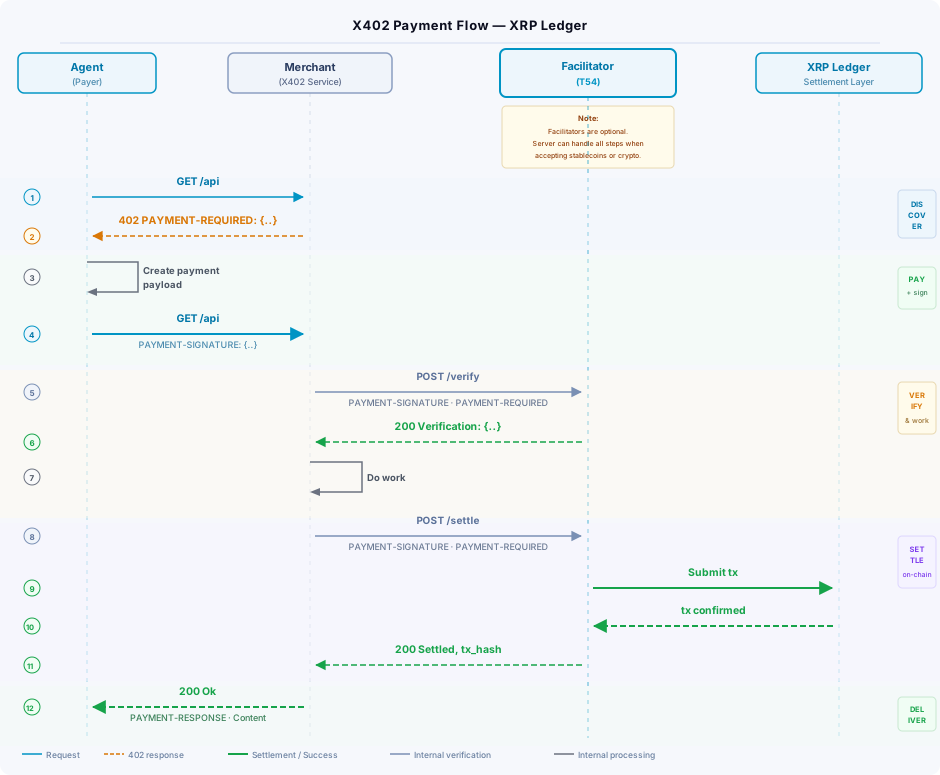
The X402 flow on the XRP Ledger involves three parties: a merchant (a service that requires payment), a payer agent (a client that pays for access), and a facilitator (a service that verifies the on-chain payment and issues a signed receipt the merchant trusts).
The complete flow:
- Agent requests a resource — the agent calls a protected HTTP endpoint.
- Merchant returns 402 — the response includes the price, the payment address, and the facilitator URL in a structured header.
- Agent sends a presigned on-chain transaction — the agent submits a presigned XRP Ledger Payment transaction from the client to the merchant's wallet address for the required amount.
- Agent obtains a receipt — the agent submits the transaction hash to the facilitator, which verifies the on-chain payment and issues a signed receipt.
- Agent retries with receipt — the agent re-sends the original request with the receipt in the
X-PAYMENTheader. - Merchant delivers — the merchant verifies the receipt and returns the resource.
The XRP Ledger's deterministic finality means step 3 is reliable: the agent knows within 3–5 seconds whether the payment confirmed, and a clean expiry means no ambiguous state to handle.
- Python 3.11+
- An XRPL wallet with a testnet balance. If you do not have one, use the XRPL Testnet Faucet to create and fund one in seconds.
- Basic familiarity with HTTP APIs.
This section shows how to protect an HTTP endpoint so that clients must pay before receiving a response.
pip install fastapi uvicorn x402-xrpl python-dotenvCreate a .env file with your merchant configuration:
XRPL_FACILITATOR_URL=https://xrpl-facilitator-testnet.t54.ai
XRPL_PAY_TO=rYourWalletAddress   # Your wallet address to receive payments.
XRPL_PRICE_DROPS=1000            # Price in drops (1 XRP = 1,000,000 drops).
# Endpoint-scoped tag. Identifies THIS endpoint's revenue, not the paying agent.
# Distinct from the XRPL AI Starter Kit agent tag (20260530) applied by the Wallet skill.
XRPL_SOURCE_TAG=20260601
The XRPL_FACILITATOR_URL above is T54's public testnet facilitator. For Mainnet, T54 operates a separate facilitator endpoint — see T54's X402 documentation for the current URLs.
The x402 SourceTag is not agent attribution.** It is chosen by the merchant and declared in the 402 payment requirements; the buying agent signs a payment carrying the server's value. It answers "which endpoint was paid?", not "which agent paid?" — the reverse of the convention in Track and Measure Agent Behavior.
- Filtering on the starter-kit tag
20260530will not find x402 payments. To audit an agent's full spend, filter by the agent's account, not by tag. - A remote server is choosing a field of a transaction your agent signs. For a tag the impact is limited to attribution, but treat the 402 response as untrusted input and do not let any other server-declared value reach a signed transaction unreviewed.
Create a file called server.py:
import os
from dotenv import load_dotenv
from fastapi import FastAPI
from x402_xrpl.server import require_payment

load_dotenv()

app = FastAPI()

# Protect the /hello endpoint with the x402 payment middleware.
# Requests that do not include a valid payment receipt receive a 402 response
# containing the payment requirements.
#
# extra={"sourceTag": ...} stamps every on-chain Payment that pays this
# endpoint with the given SourceTag, so you can filter and measure usage via
# any XRPL data API or block explorer.
# See /docs/agents/track-agent-behavior/ for more.
app.middleware("http")(
    require_payment(
        path="/hello",
        price=os.getenv("XRPL_PRICE_DROPS", "1000"),
        pay_to_address=os.getenv("XRPL_PAY_TO"),
        facilitator_url=os.getenv("XRPL_FACILITATOR_URL"),
        network="xrpl:1",   # xrpl:1 = Testnet, xrpl:0 = Mainnet
        asset="XRP",
        description="A paid hello world endpoint",
        extra={"sourceTag": int(os.getenv("XRPL_SOURCE_TAG", "20260601"))},
    )
)


@app.get("/hello")
async def hello():
    """Protected endpoint — requires payment."""
    return {"message": "Hello World! Thanks for the payment."}


@app.get("/health")
async def health():
    """Free endpoint — no payment required."""
    return {"status": "ok"}


if __name__ == "__main__":
    import uvicorn
uvicorn.run(app, host="0.0.0.0", port=8000)python server.pyVisit http://localhost:8000/hello. Without a valid payment receipt in the request, you will receive a 402 Payment Required response with the payment requirements encoded in the response headers. The /health endpoint remains free and accessible without payment.
This section shows how to build a Python agent that detects a 402 response, signs and submits an XRP payment automatically, and retries the original request with proof of payment — all without any manual intervention.
pip install requests xrpl-py x402-xrpl python-dotenvCreate a .env file with your wallet and target endpoint:
XRPL_BUYER_SEED=sYourWalletSeed                        # Your wallet seed — keep secret.
XRPL_TESTNET_RPC_URL=https://s.altnet.rippletest.net:51234/
RESOURCE_URL=http://localhost:8000/hello               # The paid endpoint to call.
NOTE: Never commit your wallet seed to version control. Use environment variables or a secrets manager. See Step 2: Generate and secure your wallet for guidance.
Create a file called client.py:
import os
import json
from dotenv import load_dotenv
from xrpl.wallet import Wallet
from x402_xrpl.clients import x402_requests, decode_payment_response

load_dotenv()

# Load your wallet from the environment — never hardcode the seed.
buyer = Wallet.from_seed(os.getenv("XRPL_BUYER_SEED"))
print(f"Buyer address: {buyer.classic_address}")

# x402_requests wraps the standard requests library.
# It automatically handles any 402 response: signs the required payment,
# includes it in the retry, and returns the final response to your code.
# The SourceTag stamped on the on-chain Payment is the one the merchant
# declares in its payment requirements (see Merchant Step 3 above).
session = x402_requests(
    buyer,
    rpc_url=os.getenv("XRPL_TESTNET_RPC_URL"),
    network_filter=None,      # Accept any network declared by the server.
    scheme_filter="exact",    # Use the exact payment scheme.
)

# Make the request. If the server returns 402, the session handles it transparently.
resource_url = os.getenv("RESOURCE_URL")
print(f"Requesting: {resource_url}")

response = session.get(resource_url, timeout=180)
print(f"Status  : {response.status_code}")
print(f"Response: {response.text}")

# The server includes payment settlement details in the PAYMENT-RESPONSE header.
payment_response = response.headers.get("PAYMENT-RESPONSE")
if payment_response:
    decoded = decode_payment_response(payment_response)
    print("\nPayment settled!")
print(json.dumps(decoded, indent=2))python client.pyThe client automatically:
- Requests the protected endpoint
- Receives a 402 with payment requirements
- Signs and submits the XRP payment on-chain
- Retries the original request with the payment receipt
- Returns the response once the server verifies settlement
This guide currently includes Python examples only.
Because x402_requests returns a standard requests-compatible session, you can drop it in anywhere your agent makes HTTP calls. The agent's main logic issues ordinary session.get() and session.post() calls; any 402 response is handled transparently without the agent needing to know about the payment flow.
A prompt that uses the XRPL skills to wire this up:
I'm building an agent that calls three external APIs. Two of them are X402-protected
and accept XRP on testnet. Use x402_requests from x402_xrpl.clients to create a
session that handles 402 responses automatically. Load the wallet seed from
XRPL_BUYER_SEED and the RPC URL from XRPL_TESTNET_RPC_URL. My agent code should
just call session.get() and session.post() without any payment logic in the
main workflow.X402 prices on the XRP Ledger are expressed in drops (the smallest unit of XRP; 1 XRP = 1,000,000 drops).
| Use case | Suggested price | Notes |
|---|---|---|
| Free tier / trial | 0 drops | Use for health checks and public endpoints |
| Lightweight API call | 100–1,000 drops | ~$0.00003–$0.0003 at $0.30/XRP |
| Standard data query | 1,000–10,000 drops | ~$0.0003–$0.003 |
| Compute-intensive / AI inference | 10,000–100,000 drops | ~$0.003–$0.03 |
For dollar-denominated pricing with price stability, x402-xrpl supports RLUSD.
Switching from testnet to Mainnet requires three changes:
- Network parameter — change
network="xrpl:1"tonetwork="xrpl:0"in both merchant and client configuration. - Facilitator URL — replace the testnet facilitator URL with the Mainnet endpoint.
- Wallet — fund a Mainnet wallet with real XRP and update
XRPL_PAY_TO(merchant) andXRPL_BUYER_SEED(payer) accordingly.
No other code changes are required. The x402-xrpl package handles the network difference transparently.
- Getting Started with Agentic Transactions — The full tutorial for setting up the XRPL skills and sending your first payment.
- Track and Measure Agent Behavior — Using
SourceTagandMemosto attribute and audit agent payments. - T54 X402 Documentation — The full X402 reference for the XRPL implementation, including the exact payment scheme and facilitator API.
- X402 Protocol Repository — The official X402 repository.