







Agentic Transactions
AI agents can discover, set up, and execute financial transactions autonomously. The XRP Ledger provides the infrastructure they need: deterministic finality, predictable costs, native multi-currency support, and compliance-ready controls — all without smart contract risk.
What Makes XRPL Agent-Ready
Purpose-Built for Autonomous Finance


Deterministic Finality
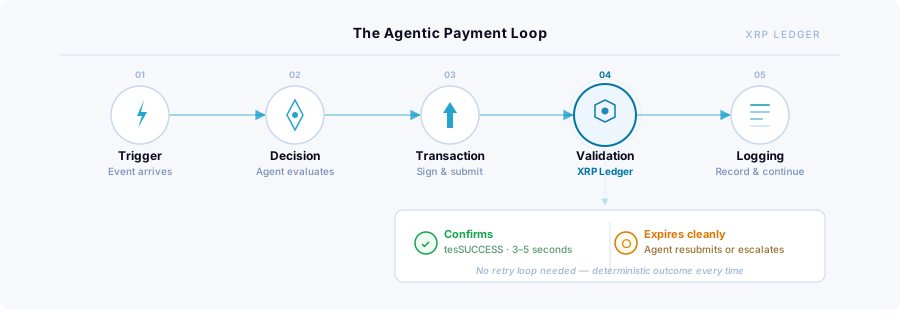
Every transaction either confirms with tesSUCCESS or expires cleanly — no hanging states, no retry loops. Agents know the outcome in 3–5 seconds and can move on.


Predictable Transaction Costs
Transaction costs are tiny and stable — fractions of a cent. Agents can plan and budget autonomously without worrying about gas spikes disrupting operations.


Native Multi-Currency & DEX
Send XRP, RLUSD, or any issued token. The built-in DEX enables atomic cross-currency settlement without bridges or third-party swap contracts.


確かな信頼性
The XRP Ledger has been processing transactions since 2012. With over a decade of production history, it provides the battle-tested infrastructure agents need for high-stakes financial automation.


No Smart Contract Risk
Core payment and escrow logic lives at the protocol layer — not in user-deployed contracts. There is no bytecode to audit, no upgrade risk, and no re-entrancy vulnerability.


Compliance-Friendly Controls
DepositAuth, multi-sig, escrow with time locks, SourceTag for agent attribution, and the Memo field for audit trails are all built in — ready for institutional workflows.
How Agentic Payments Work
The Agentic Payment Loop
Every agent-initiated payment follows the same deterministic loop. The XRP Ledger guarantees a binary outcome every time — no polling, no retry logic, no stuck transactions.
See It First
Agent Prompts → On-Chain Results
A capable agent with the XRPL skill installed can execute payments from a plain-language instruction. Here is what that looks like in practice.
Prompt
"Send 10 XRP from the operations wallet to rDestinationAddress. Log the transaction hash."
結果
→ Payment confirmed.
Hash: A1B2C3D4E5F6...
Amount: 10 XRP
Status: tesSUCCESS
Settles in 3–5 seconds. No gas estimation.
Prompt
"Pay 250 RLUSD from the operations wallet to rAcmeCorpWalletAddress. Log the transaction hash to the audit trail."
結果
→ Payment confirmed.
Hash: B2C3D4E5F6A1...
Amount: 250 RLUSD
Status: tesSUCCESS
Same finality guarantee. RLUSD is a Ripple-issued USD stablecoin on the XRP Ledger.
What an Agent Needs
Requirements
An agent that can transact on the XRP Ledger needs five things. The first three are universal; the last two are specific to AI-native workflows and make the difference between an agent that works once and one that works reliably at scale.
01
A Wallet
An XRPL account with a funded balance. On Testnet, use the faucet. In production, generate a key pair and store it securely in a KMS or HSM.
02
Network Access
A connection to an XRPL node via JSON-RPC or WebSocket. Public Testnet endpoints are available at altnet.rippletest.net.
03
A Transaction Library
xrpl-py (Python) or xrpl.js (JavaScript/TypeScript) handle serialization, signing, and submission. No raw RPC calls required.
04
Machine-Readable Docs
The XRPL Docs MCP Server exposes the full developer documentation as tool-callable context, so your LLM always has accurate, up-to-date reference material.
05
LLM Tool Interface
Optional but powerful: the XRPL Claude Skills file gives Claude pre-built tools for common operations — wallet creation, payments, escrow, and more.


Build your first agentic payment in minutes
The XRPL AI Starter Kit includes a Claude Skills file, an MCP documentation server, and a step-by-step tutorial. Connect your agent to the XRP Ledger Testnet and send your first transaction today.
Start the Tutorial